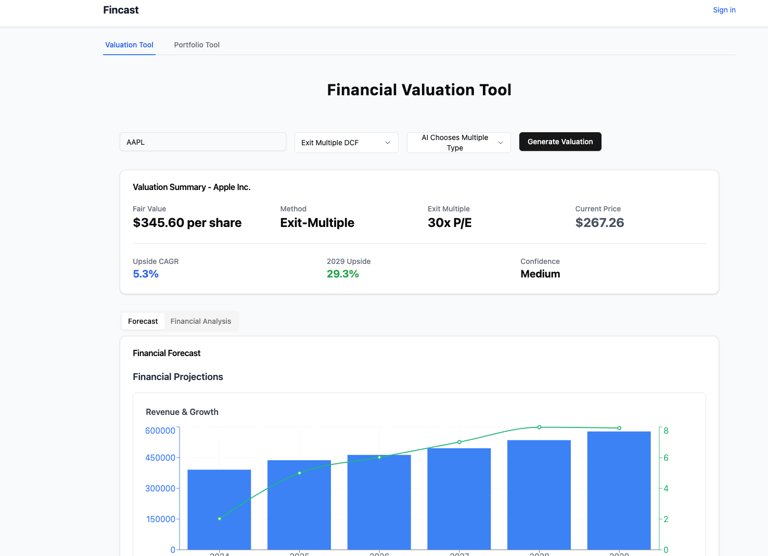
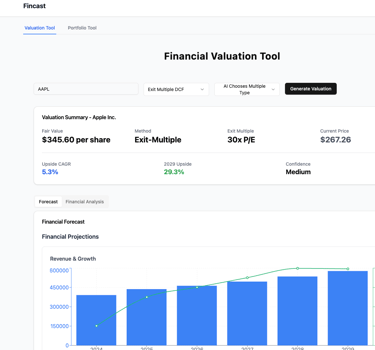
The Incentive: Traditional financial valuation is labor-intensive and prone to manual error. I wanted to automate the "bridge" between raw market data and intelligent financial projections.
The Model: Architected a full-stack platform (Next.js/Python) that integrates Perplexity and Gemini APIs with real-time market data from yfinance. The system generates automated DCF models and intelligent financial projections.
The Impact: Successfully deployed a production-grade tool that delivers automated, high-fidelity valuation analysis, enabling faster investment decision-making.
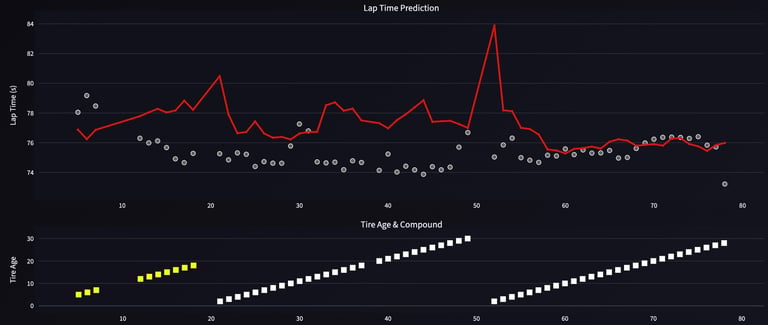
The Incentive: In Formula 1, success is defined by various interrelated physics. I aimed to uncover the hidden patterns of performance by modeling the complex intersection of physics and track conditions.
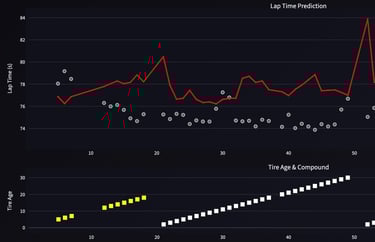
The Model: Built a physics-informed XGBoost model using 26,000+ laps of historical data. I engineered 40+ features, including tire degradation curves and fuel load physics, deployed via a Dockerized ML pipeline.
The Impact: Achieved a 4.27s mean error in lap time prediction, providing a technical framework for real-time race strategy and predictive performance analysis.
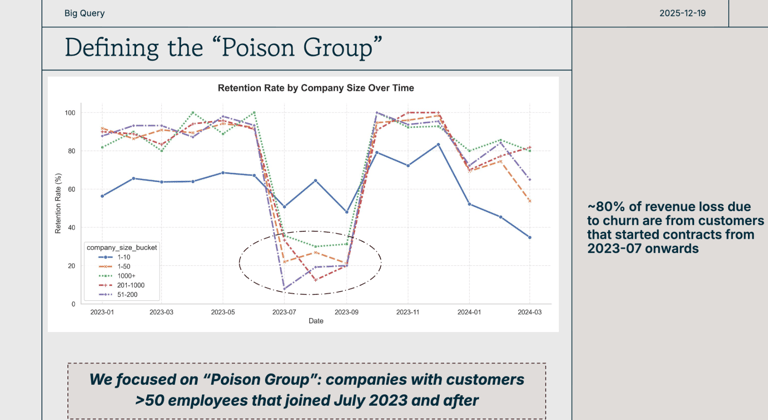
The Incentive: Identifying why a Q3 churn spike was threatening $29M in contracts. We needed to find the "poison cohort" hidden within the usage logs.
The Model: Engineered a custom productivity metric from usage logs for 3,000+ customers. We performed a causal analysis to link a 27% productivity drop to the overselling of a specific multi-warehousing feature.
The Impact: Isolated the specific cohort driving 80% of revenue loss and presented actionable sales training and product roadmap changes to Google leadership.
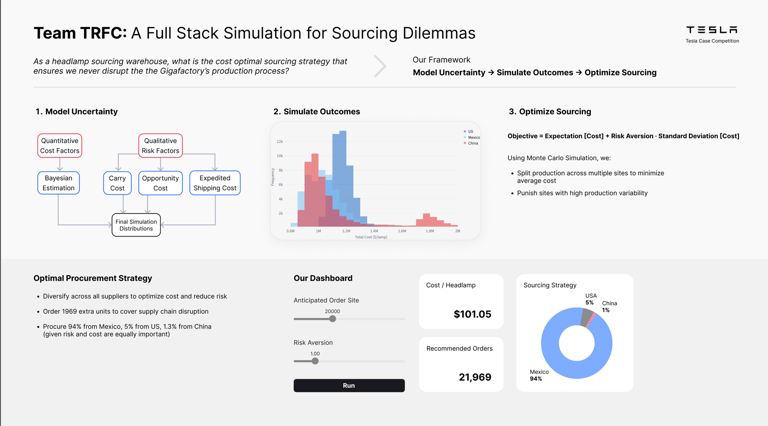
The Incentive: Supply chains for EV manufacturers are increasingly volatile. This project focused on optimizing sourcing strategies to minimize cost while maximizing resilience against geopolitical risks.
The Model: Utilized Monte Carlo Simulation, Bayesian Priors, and Linear Programming to model a multi-echelon supply chain. The model balanced procurement costs, lead times, and risk-adjusted constraints for critical light components.
The Impact: Developed an optimization framework that identified a low-cost sourcing path while maintaining a "buffer" against supply shocks, providing a roadmap for resilient resource allocation.
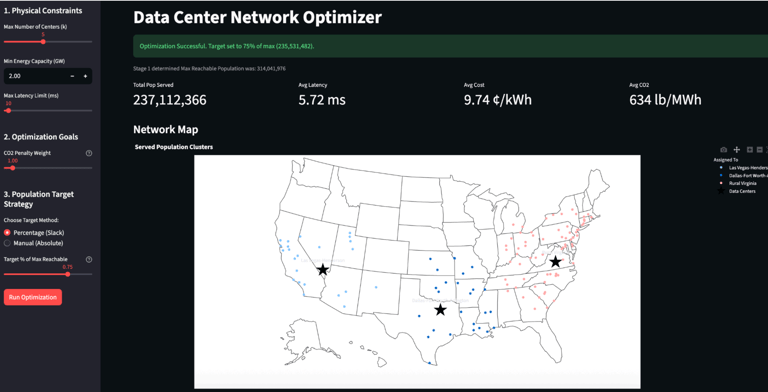
The Incentive: The massive expansion of cloud and AI is currently colliding with significant energy capacity constraints. We aimed to identify specific metropolitan areas that provide the optimal balance between serving the maximum population with the lowest latency while strictly adhering to budget constraints and aggressive decarbonization goals.
The Model: We developed a Two-Stage Mixed-Integer Linear Programming (MILP) model using Python and the PuLP library. The first stage determines the theoretical maximum population servable within physical latency limits, while the second stage minimizes the weighted sum of economic cost and carbon intensity for a target service level.
The Impact: The process resulted in an interactive dashboard that allows stakeholders to output optimal locations based on specific power, latency, and CO2 needs. Under baseline assumptions, the model identified Las Vegas-Henderson, Dallas-Fort Worth-Arlington, and rural Virginia as optimal sites—aligning with current large-scale infrastructure projects from leaders like AWS and xAI.
The Incentive: The UC Berkeley Master of Analytics program required a centralized, automated platform to manage high student demand for limited study and meeting spaces.
The Model: Architected a database-driven application leveraging Python and SQL to handle complex scheduling constraints and real-time availability. The system incorporates custom logic to enforce equitable allocation rules, preventing booking overlaps and ensuring all cohort members have access to program resources.
The Impact: Successfully deployed a Vercel tool that eliminated manual scheduling friction and eliminated booking conflicts. The platform provides a transparent user experience for the student body while optimizing the utilization of physical program assets